

Mirror Booth vs Traditional Photo Booth: Which Wins?
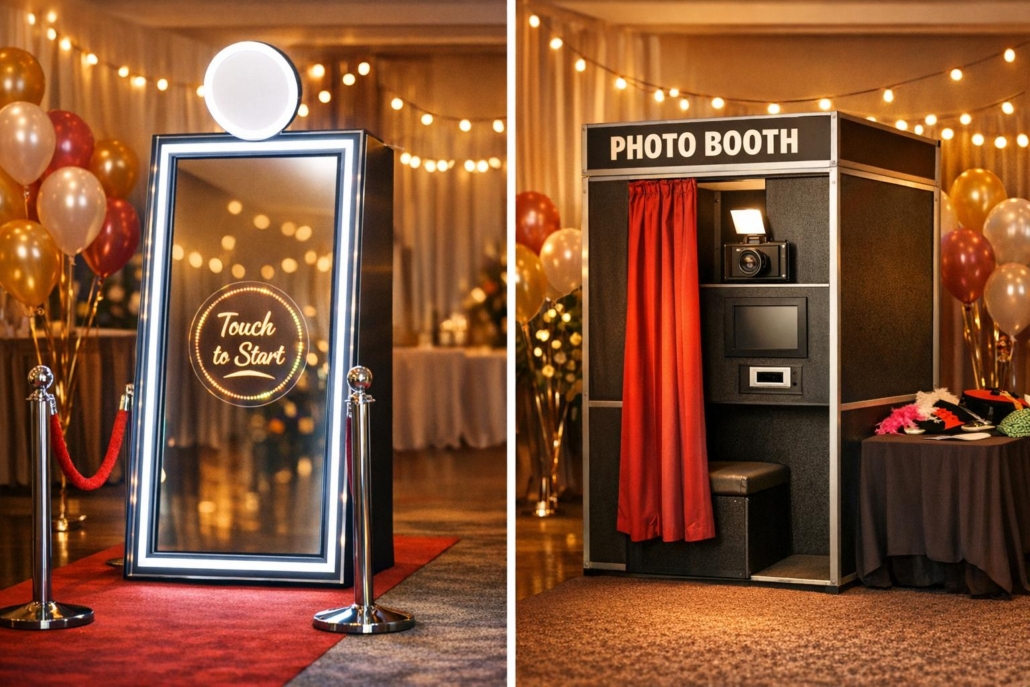
When choosing between a mirror booth and a traditional photo booth, the decision depends on your event type, target audience, and budget. Mirror booths are sleek, interactive, and ideal for high-end events like weddings and corporate galas, with rental rates ranging from $600 to $1,000+ per event. They offer modern features like touchscreens, digital props, and instant sharing, but require more effort to transport and set up.
Traditional booths, on the other hand, are budget-friendly, nostalgic, and perfect for casual events like school functions or community fairs. With costs starting at $400 per rental, they focus on simplicity, privacy, and physical photo strips but lack the modern flair of mirror booths.
Quick Comparison
| Feature | Mirror Booth | Traditional Booth |
|---|---|---|
| Design | Sleek, open-air, full-length view | Enclosed, retro-style setup |
| Interaction | High (touchscreen, animations) | Low (simple button operation) |
| Audience | Upscale, tech-savvy | Nostalgic, budget-conscious |
| Group Size | 5–8 people | 2–4 people |
| Rental Cost | $600–$1,000+ | $400–$1,000 |
| Setup | Requires 2 people, heavier | Compact but bulkier |
| Photo Options | Digital sharing, custom layouts | Physical strips only |
Mirror booths are best for luxury events, while traditional booths shine at affordable, casual gatherings. If you’re starting a photo booth business, align your choice with your market to maximize profits.
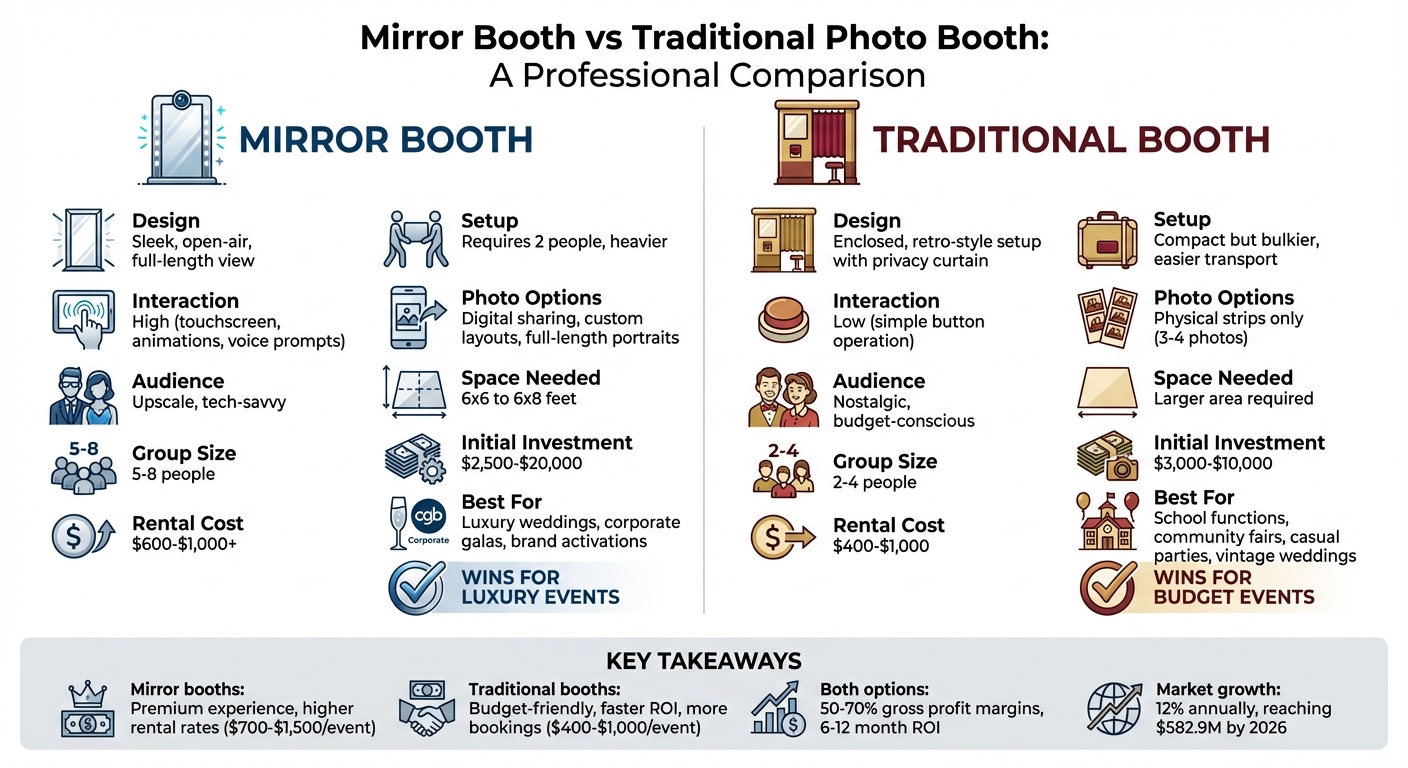
Mirror Booth vs Traditional Photo Booth Comparison Chart
The different types of Photo Booths
sbb-itb-388abf8
What is a Mirror Photo Booth?
A mirror photo booth is a sleek, full-length mirror that doubles as an interactive photo station. First introduced by Fotomaster in 2016, this modern take on the traditional photo booth combines a two-way mirror with cutting-edge technology. When activated, the mirror comes to life with animations, voice prompts, and touch controls that guide users through the photo experience.
At first glance, it looks like a regular standing mirror, often with a stylish metal frame. But as guests approach, the mirror springs into action, displaying graphics and instructions that make the experience engaging and fun. Users can tap the mirror to start, choose photo layouts, and even add emojis to their pictures.
Unlike traditional enclosed booths, mirror photo booths have an open-air design, typically measuring about 3 feet by 1.5 feet. This setup comfortably fits groups of 5 to 8 people and allows the camera to capture full-length portraits – something traditional booths can’t do. The open design is also wheelchair-friendly and works well in venues with limited space. Let’s dive into the standout features that set mirror booths apart.
Main Features of Mirror Photo Booths
The mirror’s surface isn’t just reflective – it’s also a high-definition, touch-sensitive display. Guests can see themselves in real-time as animations, countdowns, and prompts appear on the screen. The touch-sensitive glass eliminates the need for external buttons, making navigation smooth and intuitive.
One of the biggest draws of mirror booths is their ability to offer digital customizations. Guests can add digital props, apply augmented reality filters, and even use AI tools to transform their photos into artistic creations. Some systems, as early as 2025, have introduced features like "Miniature Me" transformations and aura photography. Guests can also sign their photos directly on the mirror, adding a personal touch to their keepsakes.
The booths also excel in delivering photos quickly and conveniently. High-speed dye-sublimation printers produce lab-quality prints in under 10 seconds. At the same time, digital copies can be shared instantly via QR codes, SMS, or email, making them perfect for social media. This dual option appeals to modern audiences, especially the 83% of Gen Z couples who prioritize capturing and sharing memories at their wedding receptions.
Technology and Hardware Components
The technology behind a mirror photo booth is just as impressive as its features. At its core is a professional DSLR camera – usually from brands like Canon or Nikon – positioned at eye level to ensure high-quality images. The interactive display is powered by a high-brightness LCD or LED panel, while a Windows-based computer runs specialized software like FMBooth to enable AI and augmented reality effects.
To ensure flattering photos, studio-grade lighting is built into the frame, often in the form of LED rings or professional flash systems. For events that require even more visual impact, some setups include external LED strobe lights or beauty rings.
Printing is seamless, with printers directly connected to the system. The entire unit runs on a standard 110V power outlet and requires a level floor for stability. Professional-grade mirror booths typically cost between $2,500 and $8,950, with premium "Tower" models reaching up to $15,950. Despite the initial investment, rental businesses can earn between $750 and $4,000 per event, allowing the booth to quickly pay for itself.
Best Events for Mirror Booths
Mirror photo booths are a hit at weddings, where their elegant design complements upscale décor and captures full-length shots of formal wear. Their modern look fits beautifully into luxury venues, while the interactive features keep guests entertained throughout the event. Wedding rental rates generally range from $650 for 2 hours to $1,000 for 4 hours.
Corporate events and brand activations are another great fit. The customizable interface can display company logos, branded graphics, and event-specific hashtags, making these booths perfect for product launches, trade shows, and corporate galas. Rates for such events typically range from $750 for 2 hours to $1,200 for 4 hours.
High-end parties, including Sweet 16s, galas, and upscale birthdays, also benefit from the "wow factor" of mirror booths. With features like interactive games, voice prompts, and signature options, these booths go beyond traditional photo setups to provide an unforgettable experience. Plus, their compact design requires only 3 to 5 feet of clearance in front of the mirror, making them ideal for venues with limited space.
What is a Traditional Photo Booth?
A traditional photo booth is the classic, enclosed setup you’ve likely seen at arcades or fairs. Dating back to the late 19th century, these booths have a timeless design, usually made with aluminum frames and wood paneling. They’re known for their privacy curtains or solid walls, creating a cozy, intimate space where guests can snap photos away from the crowd. This simple yet nostalgic setup has stood the test of time.
Using a traditional photo booth is straightforward. Guests step inside, position themselves in front of the camera, and press a button to start. The booth captures 3 to 4 photos in quick succession – giving just enough time for some playful pose changes. Moments later, a built-in dye-sublimation printer produces a physical photo strip, offering guests an instant keepsake to take home.
Unlike modern mirror booths with touchscreens and voice prompts, traditional booths focus purely on capturing moments. As Mark Hennings, Co-founder of Simple Booth, explains:
"Event planners will try to hide a traditional photo booth in another room, in which case many people don’t notice it and miss out on the chance to use it".
While the enclosed design encourages candid and playful photos, it does come with limitations. These booths usually accommodate only 2 to 4 people at a time, and they may not be the most accessible option for wheelchair users or small children. However, their compact size makes them easy to tuck into corners or fit into smaller venues.
Main Features of Traditional Photo Booths
Traditional photo booths are all about simplicity and charm. Their enclosed or semi-enclosed structure, often featuring privacy curtains, creates a relaxed environment where guests can let loose. These curtains – made from materials like fabric or vinyl – can even be customized to suit an event’s theme or kept classic with a vintage black finish.
Operating the booth is a breeze. Most feature a single button or basic touchscreen to start the session, with options for photo styles like color, black-and-white, or sepia. A countdown timer ensures everyone is ready before the camera flashes, making the process quick and easy.
Instead of digital effects, traditional booths rely on creative photo booth props—think hats, glasses, and quirky signs—that add personality to each session. This focus on tangible items enhances the booth’s retro charm, making it a nostalgic favorite.
Technology and Setup
Inside, traditional photo booths are designed for simplicity and reliability. The compact kiosk houses all the essentials: a high-quality camera (often a DSLR or point-and-shoot), a flash unit for proper lighting, and a PC to handle photo capture and printing.
The booth’s standout feature is its dye-sublimation printer, which produces high-quality photo strips in seconds. Unlike modern booths that emphasize instant digital sharing, traditional booths prioritize physical prints. Digital sharing is possible but often requires an additional external kiosk, which takes up more space.
While these booths are relatively easy to set up, they are heavier and bulkier compared to modern iPad-based kiosks. They require a standard 110V power outlet and enough floor space for their enclosed design. Setup typically takes 30 to 60 minutes, depending on customizations like backdrops or prop arrangements.
Best Events for Traditional Booths
Traditional photo booths shine at casual gatherings and events where nostalgia takes center stage. They’re a hit at school functions, community fairs, and birthday parties – perfect for occasions where budget-friendly, straightforward entertainment is key.
Retro-themed weddings and vintage parties are also a great match. The enclosed design and physical photo strips evoke memories of old-school arcades and boardwalk fun, adding a nostalgic touch that modern booths can’t replicate. Guests love the instant, tangible keepsakes, and the privacy curtains encourage spontaneous, playful photos.
That said, accessibility can be a concern. Traditional booths aren’t ideal for large group photos or events with wheelchair users, as the enclosed design limits space. They work best for smaller groups (2 to 4 people per session) and should be placed in a visible spot to grab guests’ attention. For larger or more inclusive gatherings, an open-air booth might be a better fit.
Mirror Booth vs. Traditional Booth: Side-by-Side Comparison
Guest Experience and Interaction
Mirror booths bring a tech-savvy twist to the photo booth experience. They feature an interactive touchscreen that guides users with animations, voice prompts, and even compliments. Guests can personalize their photos by signing the screen, adding emojis, or doodling directly on their images before printing. The open-air setup encourages onlookers to join in the fun, creating a lively and social vibe that draws attention and keeps the energy high.
On the other hand, traditional booths offer a more nostalgic and straightforward experience. Guests step inside, press a button, and pose for a series of photos. The privacy curtain provides a more intimate setting, allowing guests to be candid. However, this enclosed design can make the booth feel less prominent at events, often tucked away from the main action.
Appearance and Event Match
Mirror booths stand out with their sleek, full-length design, making them a centerpiece at elegant events like weddings and corporate galas. Their modern look blends seamlessly with upscale venues, and guests often use the reflective surface to check their appearance before snapping a photo. As Photo Booth Decor explains, "Mirror photo booths are gaining popularity due to their elegant design and interactive features."
Traditional booths, with their enclosed structure, evoke a classic, retro charm. They’re a natural fit for casual gatherings, school events, or themed parties. However, their boxy design may not grab as much attention and is often placed in less visible areas.
Space Requirements, Setup, and Transport
Mirror booths are surprisingly space-efficient, needing only about 6×6 to 6×8 feet of floor space. They’re lightweight and can usually be set up by a single operator in 30 to 60 minutes. This makes them a practical choice for venues with limited space or for solo business owners managing events.
Traditional booths, by contrast, are bulkier and require more room to accommodate their enclosed design. They often need two operators for transport and setup, which can take more time and effort.
Photo Quality and Print Options
Mirror booths use high-quality DSLR cameras and can capture full-length portraits, perfect for showcasing formal outfits at events like weddings. They also offer highly customizable print templates, allowing for event branding, hashtags, and personal messages. Guests can instantly share their photos via email or social media directly from the booth’s touchscreen.
Traditional booths stick to the classic photo strip format, typically featuring 3 to 4 landscape shots in either color or black-and-white. Prints are produced quickly with a dye-sublimation printer, giving guests a physical keepsake. However, digital sharing usually requires an additional kiosk, which adds to the setup complexity.
Feature Comparison Table
| Feature | Mirror Photo Booth | Traditional Photo Booth |
|---|---|---|
| Interaction Level | High (touchscreen, voice prompts, games) | Low (simple start button) |
| Visual Impact | Sleek, modern, full-length design | Classic, nostalgic, enclosed setup |
| Privacy Options | Open-air (social and public) | Enclosed with curtain (private) |
| Group Capacity | Larger groups (5–8 people) | Smaller groups (2–4 people) |
| Transport Ease | Lightweight; single-person setup | Bulky; requires two people |
| Photo Format | Full-length portrait or landscape | Traditional photo strips (landscape) |
| Digital Sharing | Instant via touchscreen | Requires additional kiosk |
| Modern Features | GIFs, Boomerangs, on-screen signing | Physical props and printed strips |
| Space Needed | Compact (6×6 to 6×8 feet) | Larger area required |
Business Factors for Photo Booth Entrepreneurs
If you’re planning to dive into the photo booth business, it’s essential to understand the financial and operational aspects that come with different booth types. These factors will help you align your investment with your market niche and business goals.
Initial Investment and Operating Costs
The cost of starting a photo booth business varies depending on the type of booth you choose. Mirror booths, known for their sleek and interactive designs, require an initial investment ranging from $2,500 to $4,000 for basic models. High-end options can go as high as $9,500 to $20,000 [8, 19]. Traditional enclosed booths also have a wide price range, with vintage-style models costing up to $10,000. If you’re considering open-air or standard setups, expect to spend between $3,000 and $5,000 [15, 19].
As Josh Pather, founder of Photo Booth International, advises:
"Invest at least $3,000. This will ensure you are getting a quality product with high-end customer service."
- Josh Pather
Beyond the upfront investment, ongoing monthly costs for both booth types are similar, ranging from $95 to $310. These expenses typically include software subscriptions, business insurance, and accounting tools. Additional per-event costs include:
- Printer media: $0.12–$0.25 per print
- Attendant wages: $10–$18 per hour
- Transportation: $10–$25 per event
Mirror booths, being heavier and more complex, often require a two-person team for transport and setup, increasing labor costs. On the other hand, traditional and open-air booths are more portable, allowing a single operator to handle them [6, 10]. These factors play a key role in shaping your event strategy and target market.
Target Customers and Event Types
Mirror booths shine in high-end markets, making them a favorite for luxury weddings, corporate events, and brand activations. Their modern design and interactive features appeal to clients seeking a premium experience [8, 14]. With the global wedding services market projected to hit $413.98 billion by 2030 and about 2.4 million U.S. weddings annually, the demand for such booths is substantial.
Traditional booths, in contrast, cater to more budget-friendly and nostalgic markets. They’re popular for school dances, reunions, casual birthday parties, and vintage-themed weddings. Your choice of booth should align with local demand. For example, areas with a thriving luxury wedding scene may justify the higher investment in a mirror booth. On the other hand, traditional booths are a better fit for schools or community events, offering a quicker way to enter the market.
Rental Pricing and Return on Investment
Pricing your rentals competitively is key to maximizing profits and achieving a return on your investment. Mirror booths typically command higher rates, ranging from $700 to $1,500 per event, while traditional booths rent for $400 to $1,000. Regional differences also play a role: in premium markets like New York or Los Angeles, mirror booth rentals average $900 to $1,300, whereas in Texas or Florida, rates hover around $500 to $850.
The photo booth rental business boasts strong profit margins, with gross profits between 50% and 70% and net profits of 30% to 45% for well-managed operations. Most entrepreneurs recover their initial investment within 6 to 12 months. The market itself is on the rise, growing at an annual rate of 12%, from $360 million in 2020 to an expected $582.9 million by 2026.
Josh Pather highlights the earning potential:
"Some of our PBI entrepreneurs make as much as $700 for a 3-hour event. You can theoretically break even during a single busy month during peak wedding season."
- Josh Pather
While mirror booths offer higher per-event earnings, traditional booths can achieve break-even faster due to their lower initial costs. You can also boost revenue with add-ons like branded overlays ($150–$400) or social media sharing stations ($50–$250).
Conclusion: Which Booth Type is Right for Your Business?
Choosing the right photo booth for your business boils down to aligning your options with your event goals and operational strengths. By pairing the booth’s features with your target market’s preferences, you can maximize your earnings and set your business up for long-term success.
Best Option for Luxury Events
For upscale weddings, corporate galas, and brand activations, a mirror booth is a standout choice. These booths not only command higher rental fees but also let you focus on fewer events while maintaining healthy profit margins. Their sleek, modern design, interactive touch screens, and full-length photo capabilities provide a premium experience that appeals to high-end clients. Plus, features like custom logos, personalized overlays, and data collection make them a hit at corporate events, where branding takes center stage. These extras justify the higher price tag and open the door to lucrative add-ons.
Best Option for Budget-Conscious Events
If you’re catering to school dances, community fairs, casual birthday parties, or themed weddings, traditional booths are a better fit. Their affordability and straightforward setup make them ideal for budget-friendly markets where simplicity and nostalgia are key selling points. With lower upfront costs and easier operation, these booths allow you to book more events each month and reach profitability faster.
Using Both Booth Types
Starting with one booth type that matches your current market and expanding your inventory over time can be a smart growth strategy. Offering both options not only helps you weather slower seasons but also enables you to cater to a broader audience, increasing your market share and revenue potential.
FAQs
What are the main differences in setup and transportation between mirror booths and traditional photo booths?
When it comes to setup and transport, mirror booths and traditional photo booths have some clear differences. Mirror booths tend to need more room and time to set up. You’ll usually need a 6 × 6 ft area and a flat surface to accommodate the full-length touchscreen mirror. Plus, they come with multiple components – like the glass panel, LED frame, and lighting – that all need to be assembled. These parts are often transported in separate cases, which adds to the complexity.
On the other hand, traditional photo booths are much simpler to manage. They’re compact, fit into smaller spaces, and often arrive pre-assembled or with minimal setup required. Most can be packed into a single crate or vehicle, making them a quick, plug-and-play option. This makes traditional booths a great choice for venues with limited space or tight event timelines.
How do mirror booths create a more interactive experience than traditional photo booths?
Mirror booths take photo-taking to a whole new level by making it interactive and fun. These booths feature a full-length, touch-screen mirror that lets guests see themselves as they pose. From real-time adjustments to playful on-screen options like filters, digital props, and animations, the experience feels more like a game than just snapping pictures. It’s the perfect recipe for laughter and creativity.
Unlike the enclosed setup of traditional photo booths, mirror booths offer an open design. This makes it easy for groups to jump in, strike a pose together, and enjoy the moment as a team. Plus, the ability to preview shots and interact with the mirror adds a social and seamless vibe, making it a hit at any event.
What should I consider when choosing between a mirror booth and a traditional photo booth?
When choosing between a mirror booth and a traditional photo booth, it all comes down to the kind of experience you want your guests to have. Mirror booths bring a modern edge with their sleek, full-length touchscreens, fun digital props, and instant social media sharing options. They’re a hit at lively events where tech-savvy guests want something interactive and memorable. On the flip side, traditional photo booths offer a timeless appeal. Their cozy, enclosed design and classic photo strips are perfect for creating a nostalgic, low-key vibe.
Practical details matter too. Mirror booths generally need about a 6 × 6-foot space and are user-friendly, allowing guests to operate them with ease. Traditional photo booths take up less room and are often more budget-friendly. However, keep in mind that extras like custom backdrops or branding can add to the cost. The best choice depends on your event’s goals – mirror booths shine at weddings and lively parties, while traditional booths are a great fit for smaller, more casual gatherings. Weighing your space, budget, and the atmosphere you’re aiming for will guide you to the right option.

