

How Local SEO Helps Photo Booth Owners
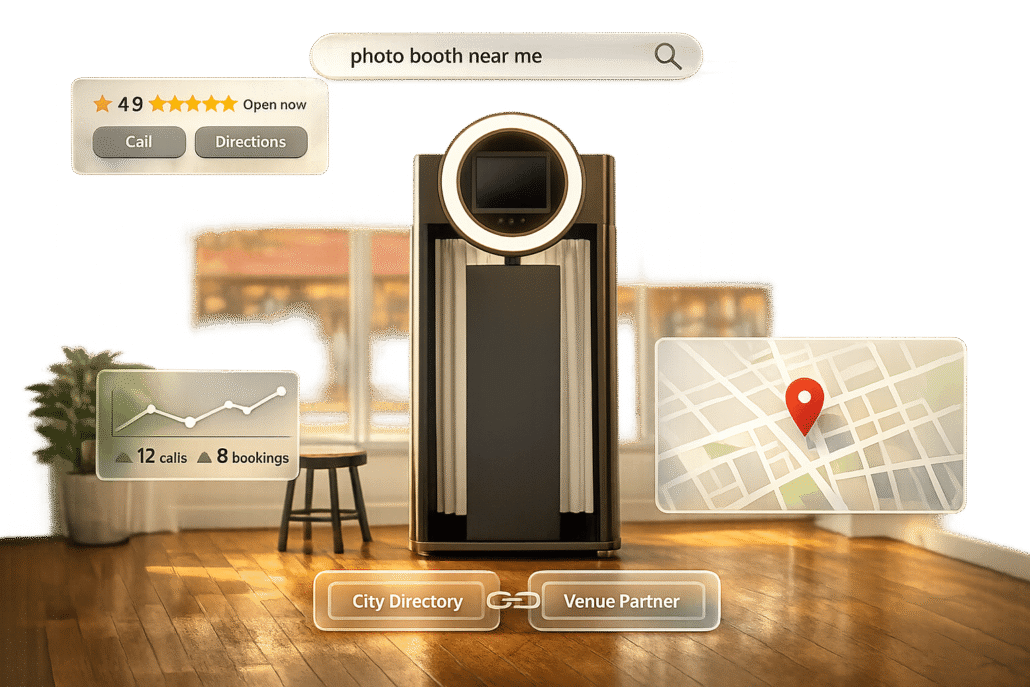
Local SEO is critical for photo booth businesses looking to attract customers in their area. By optimizing your online presence, you can appear in local search results, especially the Google Map Pack, where 54.4% of clicks go to the top three listings. Here’s why it matters and how to get started:
- Why It Matters: Most people searching for photo booth rentals are ready to book because they’re planning events with fixed dates. Local SEO ensures your business is visible when they’re searching.
- Key Benefits: Boost visibility, increase bookings, and reduce reliance on paid ads like Google Ads. For example, businesses have seen up to a 300% increase in search visibility and 40+ new monthly bookings through consistent local SEO efforts.
- Steps to Take:
- Set up and optimize your Google Business Profile (GBP) with accurate details, high-quality photos, and location-specific keywords.
- Use local keywords like "photo booth rental [City]" in your website content, meta tags, and image descriptions.
- Build local citations on platforms like Yelp, WeddingWire, and The Knot, ensuring your business details are consistent everywhere.
- Earn backlinks from local event planners, venues, and blogs to improve your site’s authority.
- Regularly update your content with local event highlights, customer reviews, and blog posts tailored to your area.
Pro Tip: Track your progress using tools like Google Business Profile Dashboard and BrightLocal to monitor rankings, customer actions, and conversions. Focus on metrics like phone calls, booking form submissions, and review velocity to measure success.
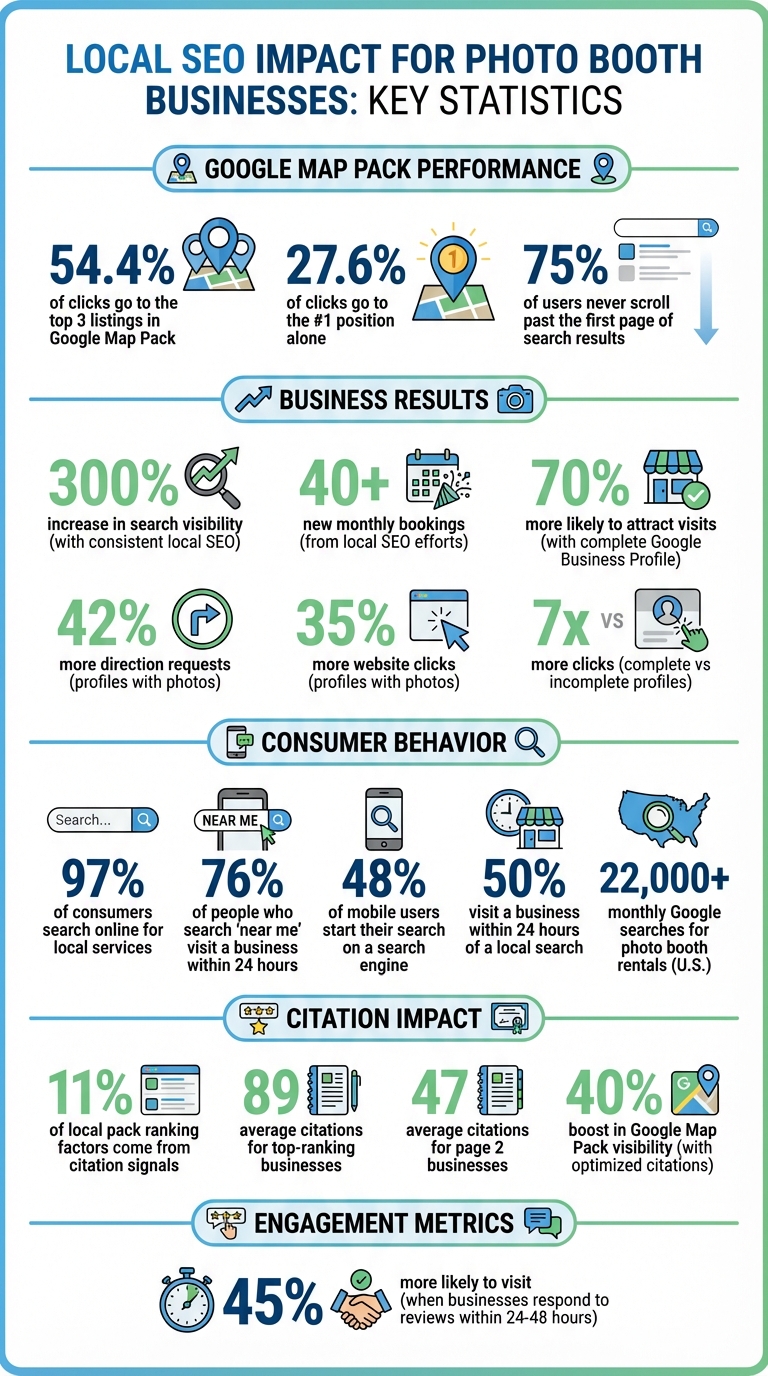
Local SEO Statistics for Photo Booth Businesses: Key Performance Metrics
Setting Up Your Google Business Profile
How to Create Your Google Business Profile
Your Google Business Profile is a free tool that helps you connect directly with customers searching for photo booth rentals. To start your photo booth business, make sure you serve customers in person – whether at your studio or at their event locations [12,14].
If you operate as a Service-Area Business, you’ll need to hide your address and list 5–6 nearby cities or major neighborhoods, such as Buckhead, Decatur, Marietta, Sandy Springs, or Alpharetta. This helps expand your service area [4,12,16].
Verification is a must. The preferred method is video verification, where you’ll record an unedited video showing your equipment, branded materials, and access to your business location [12,13]. Verified profiles tend to rank much higher than unverified ones.
"Your Google Business Profile is the most important piece of digital real estate your local business owns." – ReviewScout.ai
How to Optimize Your Profile
Start by selecting your primary category, such as "Party Equipment Rental Service", and add secondary categories like "Photo booth" or "Photographer" [4,13]. Next, upload 10–15 high-quality photos that showcase your booth options, like 360 booths, mirror booths, and props. Profiles with photos see 42% more requests for directions and 35% more website clicks. However, avoid stuffing extra keywords into your business name (e.g., "Best Photo Booth Rental"), as this could result in suspension [19,13].
Use the 750-character description to naturally include keywords like "photo booth rental in [Your City]" and highlight event types such as weddings or corporate parties [4,13].
Keep your profile fresh by updating it weekly with event highlights, seasonal promotions, or new backdrop options. Enable the messaging feature so event planners can easily reach out for quotes directly from your profile [12,13]. Responding to reviews within 24–48 hours also boosts customer engagement, making them 45% more likely to visit your business. To further enhance your profile, populate the Q&A section with common questions like "Do you provide props?" or "How much space is required?".
Lastly, make sure your Name, Address, and Phone number (NAP) are consistent across your website, Google profile, and directories like Yelp or The Knot. Inconsistent details can harm your ranking [12,13]. Businesses with complete profiles are 70% more likely to attract visits to their location.
Once your profile is fully optimized, you can focus on using location-based keywords and building local citations to boost your visibility even further.
sbb-itb-388abf8
Photo Booth SEO with Jordan St Jacques | Photo Booth Magazine Episode 5
Using Location-Based Keywords
Optimizing your website with local keywords is a smart way to connect with nearby customers, especially when starting a photo booth business, to reach those ready to take action.
How to Find Local Keywords
Combine your main services with specific location terms. For example: "photo booth rental Dallas", "360 photo booth Brooklyn", or "wedding photo booth San Bernardino." While explicit terms include the city name, phrases like "photo booth near me" rely on the user’s location data.
Google’s autocomplete feature is an easy, free tool to discover what people are searching for. Type "photo booth rental" into the search bar and see what suggestions pop up – these reflect actual searches in your area. You can also scroll to the bottom of the search results page to explore "People also search for" and "related searches" for more ideas.
For more detailed keyword research, tools like Google Keyword Planner, Semrush, and Ahrefs are incredibly helpful. Even ChatGPT can help brainstorm highly targeted phrases like "last-minute photo booth rental [Your City]."
Here’s why this matters: 97% of consumers look online for local services, and 76% of people who search "near me" visit a related business within 24 hours. On top of that, photo booth rentals generate over 22,000 Google searches per month across the U.S..
Where to Add Keywords on Your Website
The title tag is prime real estate for your local keywords. A great format could be, "Photo Booth Rental in Dallas | Top-Rated for Weddings", which clearly highlights both your service and location. In your meta description, include the keyword naturally and finish with a call to action like, "Book your Dallas photo booth today."
Your H1 tag should feature your primary keyword, while H2 and H3 tags can use related variations to create a logical structure for your content. Keep your URL slug clean and descriptive, such as yourwebsite.com/360-photo-booth-rental-chicago, instead of a random string of numbers.
"Your most valuable keyword is likely: photo booth rental [Your City]" – Aaron Traub, SEO Professional, GeauxSEO
Don’t overlook your images! Rename files with descriptive terms like "wedding-photobooth-chicago.jpg", add location-based keywords in the alt-text, and weave keywords naturally into your content – aim for 2–3 mentions per 250 words.
Stick to a "one keyword per page" rule. For instance, your homepage might target "Photo Booth Rental [City]", while individual service pages focus on specific offerings like "360 Photo Booth Rental [City]" or "Wedding Photo Booth Rental [City]." This prevents keyword overlap between pages, which could hurt your rankings. Additionally, use local keywords in your internal linking anchor text to boost relevance even further.
Once your on-page keyword strategy is solid, you can strengthen your local SEO by building citations and earning local backlinks.
Building Citations and Local Backlinks
Understanding Local Citations
A local citation is any online mention of your business’s Name, Address, and Phone number (NAP). For photo booth owners, these often show up on platforms like Yelp, YellowPages, WeddingWire, and The Knot, as well as in local news articles or wedding blogs. Think of citations as digital proof that your business is legitimate and operates in a specific location.
"Local citations are like backlinks for local SEO, except they’re easier to build and just as powerful when consistent." – Proud Marketer
Studies reveal that citation signals contribute to about 11% of local pack ranking factors. Businesses ranking at the top typically have an average of 89 citations, compared to just 47 for those on page two. Additionally, well-optimized citations can boost your visibility in the Google Map Pack by up to 40%. To ensure your listings are effective, consider using "Party Equipment Rental Service" as your primary category.
Consistency is crucial. Your business name, address, and phone number need to match exactly across all platforms. Start with major directories like Google Business Profile, Bing Places, Apple Maps, Yelp, and Facebook Business. Once these are set, expand to industry-specific sites such as WeddingWire, The Knot, Thumbtack, and Angie’s List. Tools like Moz Local (approximately $14/month) or Whitespark (around $20 per citation) can simplify and speed up this process.
Building a solid base of citations is the first step. From there, focus on developing local backlinks to further strengthen your SEO presence.
How to Get Backlinks from Local Sources
Local backlinks are another key to improving your site’s authority and visibility in search results. Partner with local wedding venues, event planners, DJs, and caterers to exchange links, often through preferred vendor lists or mutual features. Sponsoring local events, such as fundraisers or youth sports, can also lead to your logo and link being displayed on the event’s website.
Content creation is another effective way to attract backlinks. Writing articles about event planning can earn you links from authoritative local sites. Platforms like Qwoted.com allow you to connect with journalists, helping you secure mentions in high-profile publications. Don’t forget to include your website URL in your social media profiles on platforms like YouTube, Facebook, Instagram, and LinkedIn for additional backlinks.
Take Skyline Weddings in Dallas, TX, as an example. In 2025, they corrected 28 inconsistent listings and added over 80 citations on niche platforms like The Knot and Snappr. In just three months, their Google Business impressions jumped from 6,200 to 10,900, phone inquiries increased from 32 to 51, and booking form submissions rose by 42%. This demonstrates the impact of prioritizing quality over quantity – highly relevant backlinks from related industries hold much more value than a large number of low-quality or spammy links.
For photo booth rental businesses, these local strategies are essential for boosting inquiries and securing more event bookings from nearby clients.
Creating Content for Local Audiences
Writing Blog Posts About Local Topics
Crafting blog posts tailored to your local audience is a smart way to connect with nearby customers searching for photo booth services. Venue-specific guides are particularly effective. For example, you could write posts like "Top 10 Wedding Venues in [Your City]" or "Best Corporate Event Spaces in [Neighborhood]" to attract event planners actively researching venues in your area. This type of content positions you as the go-to local expert when people are looking for event planning advice tied to specific locations.
Another great idea? Event recaps. After providing your services at a well-known local venue, share high-quality booth photos in a blog post. Mention the venue and neighborhood by name to boost your local relevance. Don’t forget to use descriptive filenames for your images, like "wedding-photobooth-downtown-dallas.jpg". This small step can help your photos show up in local image searches, giving you an extra edge.
"The #1 rule is to write naturally. Use normal sentences that flow well, and try not to include a keyword more than 2-3 times every 250 words." – Guillo P, PropTrunk.com
When creating titles and headers, focus on hyperlocal keywords like "emergency photo booth [City]" or "professional photo booth [City]". These phrases are great for capturing high-intent traffic from people ready to book. Considering that 48% of mobile users start their search on a search engine and 50% visit a business within 24 hours of a local search, optimizing for these terms can directly boost your photo booth bookings.
By combining this keyword strategy with showcasing local events and customer experiences, you can further establish yourself as a trusted name in your community.
Featuring Local Events and Customer Reviews
Highlighting local events and customer stories is another powerful way to build trust and connect with your audience. Share posts featuring testimonials and photos from past events to help potential customers imagine your booth at their own gatherings. Mentioning venue names and neighborhoods in these posts strengthens your local presence even more.
To gather reviews, make it easy for customers by placing QR codes at your booth or sending follow-up emails with direct links to your Google Business Profile. Displaying these reviews from platforms like Google, Yelp, and Facebook prominently on your website can significantly boost your credibility.
"Rather than panning over your backdrop, stand out from the competition by introducing yourself. This allows leads to put a face to your name." – Josh Pather, CEO, Photo Booth International
Don’t underestimate the power of behind-the-scenes content, either. Share photos or videos of your team setting up at local landmarks or preparing props for themed events. Document your involvement in local charity galas or festivals and post it in community Facebook groups where event planners often gather. This type of content not only adds personality to your brand but also helps with local SEO by showing your active participation in the community. It’s a win-win – your business feels more relatable, and search engines take notice of your local connections.
Measuring Your Local SEO Results
Tools for Tracking Local SEO Performance
Your Google Business Profile Dashboard is an essential starting point for monitoring local SEO success. This free tool gives you insights into how often your photo booth listing appears in Google Search and Maps, along with customer actions like phone calls and direction requests. Check it weekly instead of monthly to quickly identify ranking changes or traffic spikes.
For more detailed data, Google Search Console is invaluable. It shows your "blue link" rankings below the map pack and highlights location-specific keywords driving traffic to your site. Regularly review the "Page Indexing" report to confirm that search engines can find and display your service pages. Pair this with geo-specific filters in Google Analytics to analyze traffic by city or zip code. This helps pinpoint how local visitors engage with your site and identifies which neighborhoods are converting best.
If you’re looking to track your rankings at a hyper-local level, tools like Semrush’s Map Rank Tracker or BrightLocal are excellent options. These platforms use heatmaps to show your ranking at specific street-level coordinates, helping you identify areas where you may be underperforming compared to competitors. Additionally, they can audit your Name, Address, and Phone number (NAP) consistency across directories like Yelp, WeddingWire, and The Knot, ensuring your information is accurate everywhere.
Once your tracking tools are in place, focus on the metrics that truly drive photo booth bookings.
Metrics to Monitor
Prioritize conversion metrics over general traffic stats. Actions like phone calls, direction requests, website clicks, and booking form submissions are far more valuable indicators of success. As Ben Duffy, Client Development Manager at Quirky Digital, explains:
"The best ways to measure local SEO success is by tracking conversions. Businesses invest in SEO to generate leads and maximize ROI." – Ben Duffy, Client Development Manager, Quirky Digital
Keep an eye on your Map Pack rankings for key terms like "photo booth rental [your city]." The top three results in Google capture 54.4% of all clicks, with the first result alone taking 27.6%. Track both branded searches (specific to your business name) and non-branded searches (general terms like "wedding photo booth"). Growth in non-branded searches is a strong indicator that your local SEO efforts are reaching new customers.
Another critical metric is review velocity, or how frequently you receive new reviews. Regular, recent reviews are more influential than your overall star rating, signaling to Google and potential clients that your business is active and trustworthy. A complete Google Business Profile, for example, gets 7x more clicks than an incomplete one, while listings with photos see 42% more direction requests. To dig deeper, use tools like CallRail to track phone calls generated specifically by your GBP listing or local landing pages, giving you a clearer picture of which efforts are driving bookings.
Conclusion
Local SEO isn’t just about getting noticed – it’s about turning visibility into direct bookings. When your business lands in the top three spots of the Google Map Pack, you’re reaching people who are ready to book, not just browse. As experts often point out, visibility directly impacts revenue. The more attention your business commands, the more likely customers are to choose your services.
The results speak for themselves. One local photo booth business boosted its search visibility by 300% and gained over 40 new monthly bookings simply by maintaining consistent, optimized content. Ranking organically also means you can rely less on costly Google Ads and third-party booking platforms, which helps improve your profit margins[3,7]. And with over 75% of users never venturing past the first page of search results, being locally visible is critical.
That said, local SEO is not a one-and-done effort. Search engines evolve, competitors emerge, and rankings can fluctuate without regular attention. As GO360BOOTH wisely puts it:
"SEO is an ongoing process. Regularly monitor your efforts, track your rankings, and adapt your strategy as needed to maintain and improve your search engine ranking".
To stay ahead, consistent effort is key. Regular updates to your Google Business Profile, publishing fresh content tied to local events, and encouraging customer reviews are all essential to keeping your business visible.
Think of local SEO as a long-term investment rather than a quick fix. The businesses that dominate local search are the ones that consistently upload new photos, create location-specific content, and actively engage with their communities. Without this regular effort, competitors could easily capture the calls and bookings that should be coming your way.
Start by optimizing your Google Business Profile, focusing on location-based keywords, building local citations, and tracking your progress. With persistence and attention, you’ll see more bookings roll in as local customers discover your photo booth services right when they need them.
FAQs
How long does local SEO take to increase photo booth bookings?
Local SEO can start boosting photo booth bookings in as little as a few weeks, though the exact timeline depends on factors like the level of competition in your area and how consistently you apply optimization strategies. With regular effort, many businesses begin to see measurable improvements within about 14 business days to a few months.
Should I hide my address on Google if I travel to events?
For local SEO, displaying your address on Google is usually the smarter choice. A complete and accurate Google Business Profile not only boosts your local visibility but also helps attract clients in your area.
If you’re someone whose address changes often – like when traveling – it might make sense to hide it to avoid confusing potential customers. But for most photo booth owners, keeping the address visible is crucial for securing local bookings and improving your search rankings.
What should I track to know local SEO is working?
Tracking your local SEO performance involves keeping an eye on several key factors. Start by checking your website’s rankings for local keywords, such as "photo booth rental in [Your City]". This will give you a sense of how well you’re appearing in search results for your target audience.
Next, pay attention to your Google My Business listing. Is it showing up prominently in local searches? If so, that’s a great sign your efforts are paying off.
You’ll also want to measure tangible results like local leads, calls, and bookings generated from search engines. These metrics can offer clear evidence of how your SEO strategies are driving business. Lastly, don’t overlook website traffic from local sources – this can help you gauge how well you’re connecting with nearby customers.
As your rankings improve and positive online reviews increase, it’s a strong indicator that your local SEO strategy is on the right track.
