

Ultimate Guide to Photo Booth Branding
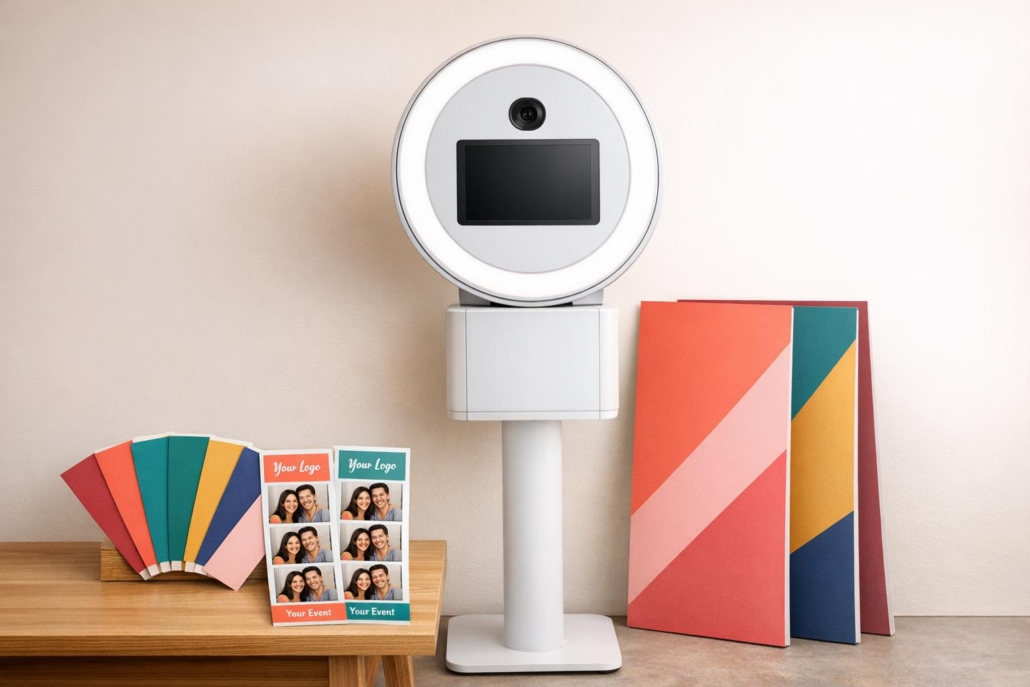
Photo booth branding transforms every photo into a marketing tool. By featuring your logo, colors, and designs on booths, backdrops, and templates, you create a recognizable identity that attracts clients and turns event guests into promoters. This approach boosts trust, recall, and bookings, helping you succeed with profitable photo booth business opportunities in a competitive market.
Key takeaways:
- Why branding matters: Builds trust, secures bookings, and spreads awareness through guest-shared photos.
- Visual identity essentials: A memorable logo, cohesive colors, and typography that match your brand’s personality.
- Custom elements: Use booth wraps, branded templates, and props to reinforce your identity.
- Social media impact: Branded hashtags, QR codes, and shareable photos amplify your reach.
- Tracking success: Measure impressions, engagement, and leads to refine your strategy.
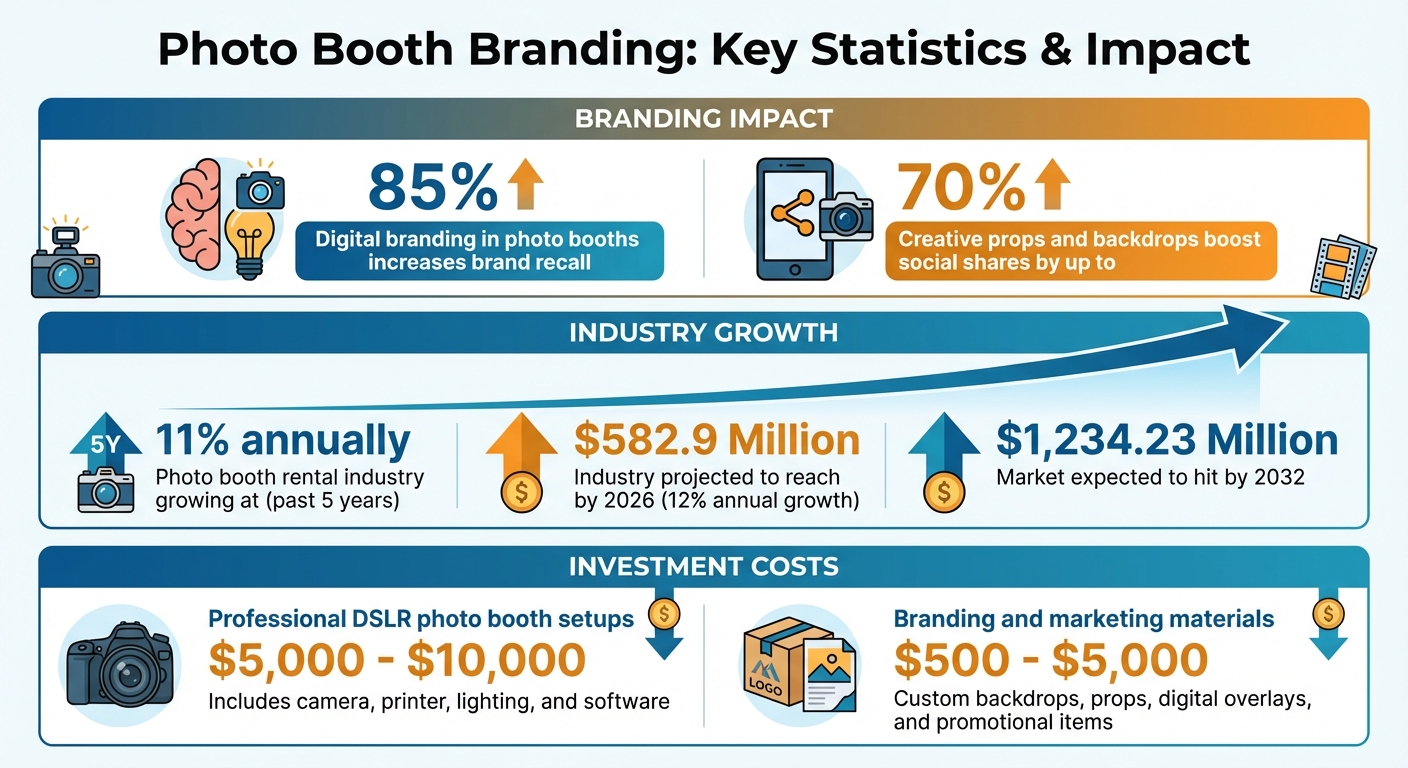
Photo Booth Branding Impact Statistics and Industry Growth
Market Your Salsa Photobooth To Corporate Clients How To Created Branded Elements in Canva
Building Your Visual Brand Identity
Your visual identity is an extension of your business’s core branding strategy. It includes elements like your logo, color palette, typography, and imagery style, all working together to create a recognizable and lasting impression. For photo booth businesses, this goes beyond just digital assets – it includes physical components like booth wraps, backdrops, props, and print templates.
When your visual elements are consistent, clients and guests can instantly associate your logo on a photo strip or booth wrap with your business. This consistency not only reinforces credibility but also ensures your brand is top of mind when someone needs photo booth services.
Creating a Memorable Logo
A strong logo acts as a visual anchor for your business. It should be versatile enough to look great at any size, whether it’s a tiny social media icon or a large booth wrap. Always test your logo across different sizes to ensure it remains clear and visually appealing.
"Customers who are getting to know a business need something to remember it by, and a logo can act as a visual souvenir for people to hang on to." – Amanda Leigh
To stand out, steer clear of overused clichés like "snap", "click", "smile", or "cheese" – this helps your brand remain unique and easier to find online. Aim for a name that’s distinctive and easy to remember. If it’s a one-word name, keep it under four syllables; for two-word names, stick to four syllables total.
Keep a master file of your logo in vector formats like AI or SVG for scalability, and create PNG and JPG versions for digital and print use.
Beyond the logo, your choice of colors and fonts will further shape your brand’s personality.
Choosing Brand Colors and Typography
Colors play a powerful role in evoking emotions and shaping how clients perceive your business. For example:
- Blue: Suggests trust and reliability, ideal for corporate events.
- Red: Represents passion and energy, great for weddings and lively celebrations.
- Black: Exudes elegance and luxury, perfect for formal galas.
- Orange and Yellow: Convey creativity and fun, fitting for birthdays or festivals.
Start by identifying the emotions you want your brand to communicate. Are you aiming for a sleek, modern vibe? A romantic, vintage feel? Or perhaps something fun and playful? Use tools like Pinterest or Instagram to build a mood board, collecting images that reflect your desired aesthetic. Look for recurring color patterns in these images to define your primary palette.
Typography works in a similar way. Sans-serif fonts (like Arial or Helvetica) give off a modern and innovative vibe, while serif fonts (like Times New Roman or Georgia) feel more traditional and dependable. Choose one font for headlines and another for body text, ensuring readability by keeping website text sizes around 18 pixels.
Once your visual elements are set, a brand style guide will help you maintain consistency across all platforms.
Developing a Brand Style Guide
A brand style guide ensures consistency at every touchpoint, from photo templates to email signatures. Without one, your brand risks looking disjointed, which can confuse potential clients and weaken its impact.
Your style guide should include:
- Logo specifications: Details on formats and where to use them.
- Color palette: Exact hex codes for your chosen colors.
- Typography: Approved fonts, sizes, and usage guidelines.
- Imagery style: Guidelines for photos and visuals.
It should also define your brand’s voice and tone – whether you’re "fun and modern" or "professional and elegant" – to ensure consistent communication with clients. If you have a tagline or slogan, keep it concise (under five words) and include it in the guide.
Since branding and marketing materials can cost anywhere from $500 to $5,000, having a style guide protects that investment by keeping your identity consistent and professional.
A cohesive visual identity does more than just make your brand recognizable – it builds trust and drives growth for your business.
Customizing Photo Booth Elements
Tailor your photo booth to reflect your brand’s personality – both in its physical appearance and digital features. Every detail, from the booth’s exterior to the photos it produces, leaves an impression and helps create a lasting connection with your audience.
Wrapping your booth in branded vinyl graphics not only makes it visually appealing but also transforms it into a powerful marketing tool that grabs attention at events. Pair this with custom backdrops featuring your colors and messaging, and you’ve got a cohesive setup that guests will remember. This approach works: adding digital branding to photo booths has been shown to boost brand recall by 85%. Plus, when attendees share their photos on social media, they’re essentially promoting your business, extending your reach far beyond the event itself.
Here’s how you can enhance your booth, from wraps to digital templates.
Backdrops and Booth Wraps
Custom vinyl wraps don’t just look great – they send a message of professionalism and quality. A well-designed wrap can turn your booth into the centerpiece of any event, helping you stand out from competitors who might offer less polished setups.
Your backdrop is the canvas for every photo, so it must align with your brand’s colors and style. With open-air photo booths gaining popularity, you’ll have more flexibility to incorporate custom backdrops and optimize lighting compared to traditional enclosed booths. To make an even bigger impact, consider adding LED lights in your brand colors to the booth exterior. This is especially effective in low-light venues like evening weddings or dim conference halls.
Don’t forget to test your logo’s scalability across different formats before committing to large-scale printing. Investing in quality branding materials is especially important when professional DSLR photo booth setups can cost anywhere from $5,000 to $10,000.
Branded Photo Templates and Overlays
Every photo should subtly showcase your brand. Add overlays that include your logo, website, contact information, and event-specific hashtags.
"A digital photo booth provides your brand with a wealth of user-generated content (UGC) to use in your marketing efforts." – Josh Pather, Founder, Photo Booth International
Design templates for standard print sizes, like 2×6-inch strips or 4×6-inch photos, which typically feature one to four images per session. Beyond the photos themselves, customize every touchpoint – like the "Tap to Start" screen, activation buttons, and email templates – to reflect your brand’s style. This consistency ensures a smooth, branded experience from start to finish.
Want to maximize your booth’s impact? Add QR codes to printed photos that link to your website or special discounts. For digital outputs, try creating animated GIFs with your branding – movement grabs attention more effectively than static images.
Next, let’s explore how props can add even more personality to your setup.
Props and Themed Elements
Props add a playful element to your booth and reinforce your brand without overshadowing the photos.
"Personalized props, such as photo booth signs, add a unique touch and encourage more engaging and shareable moments." – Photo Booth Decor
Match props to the event theme – think rustic materials for barn weddings, sleek and modern designs for corporate gatherings, or vibrant colors for birthday parties. Include signs featuring your branded hashtag to encourage guests to tag your business on social media, giving your brand even more exposure.
Choose props that are durable and photograph well under different lighting conditions. While physical props provide a tactile, interactive experience, many modern digital booths now offer virtual props like animated stickers and custom filters. These digital options are easy to update for different campaigns and events. With the photo booth rental industry growing by about 11% annually over the past five years, standing out with creative and branded elements is more important than ever.
sbb-itb-388abf8
Using Social Media to Amplify Your Brand
Once you’ve established your visual brand identity, social media becomes a powerful tool to spread your message further. Photo booths are a great example – they create shareable content, turning every snapshot into a piece of advertising. When guests share these photos, your branding reaches their entire network, creating a ripple effect of exposure.
The trick is to make sharing effortless. Modern photo booths can send images instantly via text or email, complete with your branding already embedded. By including your logo and website on each photo, every share acts like a mini billboard, potentially reaching hundreds or even thousands of people.
Next, unify your online presence by creating a custom hashtag for your brand.
Creating and Promoting Branded Hashtags
A branded hashtag serves as a digital thread that ties all event-related content together, making it easier to track your presence online. Keep it simple and memorable – guests are more likely to use a short, easy-to-spell hashtag. For instance, instead of something long like #AmazingPhotoBoothExperiencesLosAngeles, go for #LAPhotoBooth or combine your business name with the event type.
"A branded hashtag can be more than just your company name. Get creative and think outside the box to make hashtags that match the voice and tone of your brand." – Photo Booth International
To boost visibility, display your hashtag prominently on the photo booth, backdrop, and touchscreen. You can also use variations to capture different search behaviors – both #PhotoBoothLosAngeles and #LosAngelesPhotoBooth work well. Keep in mind that Instagram suggests using three to five hashtags per post to avoid coming across as spammy.
Encouraging Social Media Sharing
To get guests excited about sharing, introduce contests and rewards. For example, run a competition for the "funniest photo" or "best pose", offering prizes to winners who post using your branded hashtag. You can also add QR codes to printed photos that link to special offers or discount codes, giving guests an extra incentive to engage with your brand .
Content format matters, too. Animated GIFs and short videos tend to grab more attention than static images, helping to showcase your brand’s personality and encourage even more sharing. When guests receive their photos via email, include a clear call-to-action asking them to tag your business on platforms like Instagram or Facebook.
Don’t stop there – repost user-generated content to your business accounts. This type of content serves as authentic social proof, showing potential clients what your events look like. This is a key part of photo booth marketing for beginners looking to build trust. Creative props and backdrops can further boost exposure, with some studies suggesting they increase social shares by up to 70%.
Once people start sharing, it’s important to track the results to fine-tune your strategy.
Tracking Social Media Engagement
Measuring engagement is key to understanding the impact of your social media efforts. Start by tracking how often your branded hashtag is used – that’s a good indicator of your event’s reach . Dive into metrics like likes, comments, and shares to see which types of content resonate most with your audience.
Platforms like Instagram and Facebook offer built-in analytics to help you monitor impressions (how many people saw your content) and reach (the number of unique users exposed to it). Many photo booth software solutions also provide real-time analytics, showing how many photos were shared and where they ended up.
| Metric | What It Tells You |
|---|---|
| Impressions, hashtag usage, total reach | How many people saw your brand |
| Likes, shares, comments | What content your audience enjoys |
| Website clicks, booking inquiries | How social media impacts your business |
| User-generated posts, video views | Authentic proof of your brand’s appeal |
Conversion metrics – like how many social interactions lead to website visits or booking inquiries – are especially important for gauging whether your social strategy is driving real business results. With the photo booth industry projected to hit $1,234.23 million by 2032, standing out on social media is more important than ever for staying competitive.
Measuring and Improving Your Branding Strategy
Once your brand is up and running, the next step is figuring out what’s working and what isn’t. To do that, you need to track the right metrics. These insights will show you if your branding efforts are hitting the mark or if it’s time to make some changes.
Key Metrics to Measure Branding Success
Start by keeping tabs on brand awareness. This includes impressions, hashtag reach, and brand recall. A fun way to measure "visual brand exposure" is by multiplying the seconds your logo is visible by the number of photos taken. Research even shows that using digital branding in photo booths can boost brand recall by 85%.
Customer engagement metrics are another must-watch. See how people interact with your booth by tracking guest traffic, how long they stay (dwell time), and how often they come back during events.
When it comes to lead generation, focus on how many email addresses or phone numbers you collect. Follow up to see if those leads convert into actual bookings. Also, keep an eye on redemption rates for any QR codes or digital coupons you include on photos.
Here’s a quick breakdown of what to track and how to measure it:
| Metric Category | What to Track | How to Measure |
|---|---|---|
| Awareness | Impressions, hashtag reach, visual exposure time | Hootsuite, Sprout Social, brand recall surveys |
| Engagement | Booth traffic, dwell time, repeat visitors | Foot traffic counters, beacons, RFID |
| Business Growth | Leads collected, conversion rate, repeat bookings | CRM (Salesforce), Google Analytics, booking software |
| Sentiment | Net Promoter Score (NPS), review ratings | Qualtrics, SurveyMonkey, Google/Facebook reviews |
While these numbers are essential, don’t stop there. Pair your data with direct customer feedback to get the full picture.
Collecting Feedback from Customers
Customer feedback is your secret weapon for understanding how people feel about your brand. Automate follow-up emails after events or use your booth software to gather quick ratings. To make feedback more targeted, use survey branching to ask specific questions about your logo, colors, and overall experience.
"Innovation needs to be part of your culture. Customers are transforming faster than we are, and if we don’t catch up, we’re in trouble." – Ian Schafer, Founder, Deep Focus
Ask questions like: Does your logo look modern? Do the colors match the vibe they expected? Did the experience at your booth align with what they saw on your website or social media?
To encourage participation, offer incentives like discounts or contest entries for completing surveys or sharing branded content. And don’t forget to close the feedback loop – let customers know when their suggestions lead to improvements, such as new backdrop options or a more streamlined booking process.
By combining metrics with customer feedback, you’ll have a solid foundation to adjust your branding strategy.
Adjusting Branding Based on Data
Now that you’ve got the data and feedback, it’s time to put it to work. Use A/B testing to fine-tune elements like logo placement, hashtag strategies, and call-to-action prompts. For example, test whether your logo gets more attention in the top-right corner versus the bottom-center of photo overlays.
"The businesses that win are those that launch quickly, test constantly, and systematize everything." – Josh Pather, Founder, Photo Booth International
If your social shares are low, try adding more eye-catching props. If people aren’t spending much time at your booth, take a closer look at the setup – maybe it’s not inviting enough, or the instructions aren’t clear. Integrating your photo booth data with a CRM like Salesforce can also help track Customer Lifetime Value (CLV) and figure out which branding tweaks lead to repeat bookings.
Use these insights to sharpen your brand’s visual identity and customer experience, creating a stronger, more cohesive image that resonates with your audience.
Conclusion
Building a strong photo booth brand is about more than just designing a logo – it’s about crafting an experience that sticks with people. Your brand is reflected in every interaction, from the first time someone visits your website to the moment they step into your booth. By keeping things consistent – whether it’s your website design, social media presence, booth wraps, photo templates, or even your email signature – you create a visual identity that’s instantly recognizable and earns your clients’ trust. This cohesive experience doesn’t just define your brand; it also drives real results for your business.
But a great brand isn’t just about looking good. It’s about standing out. Defining your Unique Selling Proposition (USP) is key to carving out your place in the market, whether you specialize in upscale weddings, corporate events, or local community gatherings. With the photo booth industry expected to hit $582.9 million by 2026, growing at 12% annually according to our photo booth business guide, differentiation is no longer optional – it’s necessary.
Start with the essentials: a logo that scales well, a purposeful color palette, and a consistent brand voice. Then, bring your brand to life at events with custom booth wraps, branded photo overlays, and props that align with your style. Use tools like branded hashtags and QR codes to turn event guests into brand ambassadors, extending your reach far beyond the booth.
In a crowded market, a polished and professional brand sets you apart. That credibility leads to more bookings, repeat business, and valuable word-of-mouth referrals. To keep your brand sharp, regularly test your visuals, refine your messaging, and listen to customer feedback. The businesses that thrive are the ones that launch quickly, adapt constantly, and stay true to their identity. A memorable brand isn’t just an asset – it’s a growth engine.
FAQs
How can I evaluate the success of my photo booth branding efforts?
To determine how well your photo booth branding is working, keep an eye on key performance indicators (KPIs) that highlight engagement and visibility. Pay attention to metrics like the number of photos taken, social media shares, and the overall level of interaction with your booth. When engagement is high, it’s often a sign that your branding is resonating.
If your goals are more business-oriented, focus on tracking website traffic, lead generation, and social media activity to assess how effectively your branding is driving awareness and customer connections. Gathering feedback – whether through surveys or direct comments – can also give you a clearer picture of how people perceive your brand and where you might improve.
Real-time analytics tools can be a game-changer. They provide immediate insights into how your booth is being used and how well it’s capturing audience interest during events, allowing you to fine-tune your branding strategies on the spot.
What are the best tips for designing a standout logo for a photo booth business?
Creating a logo for your photo booth business is all about capturing the essence of your brand while making a strong impression. Keep it simple – use clean, playful imagery and fonts that match the fun, interactive vibe of photo booths. A great logo should not only be eye-catching but also reflect what your business stands for and be easy to recognize at a glance.
Your logo should also be adaptable. It needs to look sharp on everything from booth exteriors and photo strips to props and marketing materials. Choose colors and dimensions that work well in both digital and print formats. A thoughtfully designed logo doesn’t just boost brand recognition – it also makes your business more attractive to clients hosting weddings, parties, or corporate events.
What are the best ways to use social media to boost my photo booth brand?
Building a strong presence on social media can work wonders for your photo booth business. Start by sharing eye-catching, high-quality photos or videos of your booth in action. Think about using consistent colors, branded props, and stylish backdrops to create a recognizable identity that people will remember.
Encourage guests to share their fun moments by using branded hashtags or tagging your account. This simple step can help expand your organic reach as their posts introduce your brand to their followers. You can take it a step further by adding your logo or custom overlays directly to the photos. That way, every time someone shares an image, your brand gets a little spotlight.
Don’t forget to engage with your audience! Reply to comments, repost user-generated content, and stay active on your platforms. These interactions not only boost your visibility but also help you build a community of loyal followers who feel connected to your brand.

